

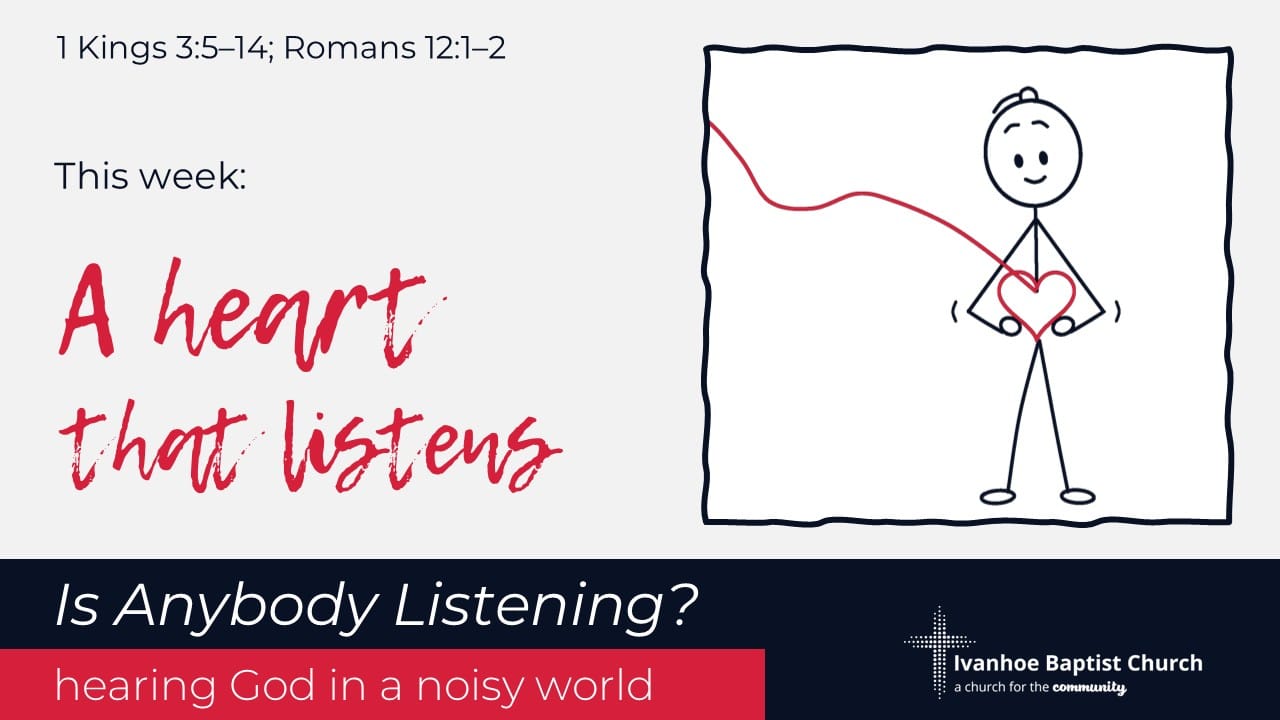
This week we read one passage a day about a heart that listens: asking God for wisdom, trusting him with the whole heart, staying planted when the world presses us into its shape, and making room to sit at Jesus’ feet. Set aside a few quiet minutes, read slowly, and finish with the short prayer and practice. Each day’s practice is a small step into this week’s examen, five minutes at the end of the day to look back over it with God, give thanks, and ask for wisdom for tomorrow. Nothing has to happen. As Paul puts it, we are “transformed by the renewing of the mind, so that you may discern what is the will of God.”
Ask God
A short promise for anyone who needs wisdom, and a word about asking with a whole heart.
James is writing to believers scattered far from home, people facing "various trials" (1:2). Almost at once he tells them what to ask for: "If any of you is lacking in wisdom, ask God, who gives to all generously and ungrudgingly, and it will be given you" (v. 5).
On Sunday Craig asked what we usually pray for when something big is coming up. Most of us reach for a list: strength, success, a way around the obstacles, the right people on side. James's list has one thing on it. And the promise is open to "any of you". Solomon's dream at Gibeon came to a king at one moment in Israel's story, and we aren't promised a dream like his. We are promised what he asked for, because James says that God offers it to all who ask.
Look at how God gives. The Greek word behind "generously" means simply, without holding anything back. "Ungrudgingly" means without reproach: God doesn't sigh, or remind us how often we've asked before. We can't wear out this welcome.
Then James adds a condition: "But ask in faith, never doubting, for the one who doubts is like a wave of the sea, driven and tossed by the wind" (v. 6). He calls that person "double-minded" (vv. 7–8), and the Greek word means two-souled. This isn't about having questions. Plenty of faithful people pray with questions. James is describing a divided heart, one that asks God for wisdom while keeping a second plan ready in case the answer is inconvenient. The wisdom God gives is for walking in, and he gives it to people who mean to walk.
- When something big is coming up, what do I usually ask God for? What would change if I asked for wisdom first?
- Is there a decision where I'm asking for God's wisdom but keeping a second plan in my back pocket?
Scripture quotations are from the New Revised Standard Version Updated Edition. Copyright © 2021 National Council of Churches of Christ in the United States of America. Used by permission. All rights reserved worldwide.
With All Your Heart
A parent's advice about trusting God with the whole heart.
The book of Proverbs opens with Solomon's name: "The proverbs of Solomon son of David, king of Israel" (1:1). In chapter 3 a parent is talking to a child: "My child, do not forget my teaching, but let your heart keep my commandments" (v. 1). Read the first eight verses slowly and watch for the heart. It keeps the teaching (v. 1). It is the tablet where loyalty and faithfulness are written (v. 3). And it is what we trust with: "Trust in the LORD with all your heart" (v. 5).
In Hebrew the heart is the centre of the whole person. It thinks and decides as well as feels. That's why, when Solomon asked for what is literally a listening heart (1 Kings 3:9), English Bibles translate it "an understanding mind". So "all your heart" includes the mind as well as the feelings. A later chapter puts it like this: "Keep your heart with all vigilance, for from it flow the springs of life" (4:23).
"Trust in the LORD with all your heart, and do not rely on your own insight. In all your ways acknowledge him, and he will make straight your paths" (vv. 5–6). The Hebrew word behind "acknowledge" is the ordinary word for knowing someone. Know him in all your ways: at work, at home, in the car, at the shops, as well as on Sunday. It's easy to plan a week on our own and thank God at the end if it went well. This proverb pictures something closer, knowing him along the way, one step at a time.
"Do not be wise in your own eyes" (v. 7). Wisdom begins with knowing we need it. Solomon's own later story is a reminder that a heart which once listened still needs keeping. When he was old, the writer of Kings says, "his heart was not true to the LORD his God" (1 Kings 11:4). The gift had been real. It still needed tending, and so does ours.
- Which parts of my life do I tend to bring to God only after they're done?
- What would it look like to know God along the way in one ordinary part of tomorrow?
Scripture quotations are from the New Revised Standard Version Updated Edition. Copyright © 2021 National Council of Churches of Christ in the United States of America. Used by permission. All rights reserved worldwide.
Planted by Streams
Two ways to live, and a tree that grows by the water.
Psalm 1 stands at the door of the whole book of Psalms. "Happy are those who do not follow the advice of the wicked or take the path that sinners tread or sit in the seat of scoffers" (v. 1). In Hebrew the three verbs are walk, stand and sit. Read that way, the verse describes a slow drift: walking along with a way of thinking, then stopping on its path, then settling into its seat. Nobody is pressed into a new shape in a single step.
Paul names the same drift: "Do not be conformed to this age" (Romans 12:2). The pressure of an age rarely shouts. It hums in the background, like a fridge you only notice when it switches off: the ads promising that a good life needs one more thing, the pace everyone else keeps, the quiet assumption that we can manage on our own and fit God in where he's useful. We stop hearing it because it's everywhere.
The psalm answers with a delight: "but their delight is in the law of the LORD, and on his law they meditate day and night" (v. 2). The Hebrew word for "meditate" means to murmur, as if reading half aloud. It is slow, repeated reading, the kind that lets God's word sink in until it becomes the voice we hear underneath all the others.
"They are like trees planted by streams of water, which yield their fruit in its season, and their leaves do not wither" (v. 3). The river red gums along the Yarra are like that. They stay green through the driest summer, not because they strain, but because their roots run down to the water. Romans 12:2 works the same way. "Be transformed" is passive in Greek: it is something God does in us, over time. Our part is to stay planted where the water is.
- Walking, standing, sitting: where have I drifted into the shape of the world around me without noticing?
- What helps God's word sink in for me, so that it becomes a delight and not only a duty?
Scripture quotations are from the New Revised Standard Version Updated Edition. Copyright © 2021 National Council of Churches of Christ in the United States of America. Used by permission. All rights reserved worldwide.
Only One Thing
Two sisters, one guest, and the one thing needed.
As Jesus travels, "a woman named Martha welcomed him" (v. 38). Luke tells this straight after the parable of the good Samaritan (10:25–37), a story about practical love, so there is no hint that Martha's work doesn't matter. Her sister Mary "sat at Jesus's feet and listened to what he was saying" (v. 39). The Greek tense suggests she kept on listening.
"But Martha was distracted by her many tasks" (v. 40). The Greek word for "distracted" pictures being pulled away, dragged in several directions at once. The word for her "tasks" is the word for service, the same word the New Testament uses for ministry. Martha is doing a good thing. The trouble is what it is doing to her. She ends up worried, resentful, and telling Jesus what to do: "Tell her, then, to help me."
Jesus answers gently, and says her name twice: "Martha, Martha, you are worried and distracted by many things, but few things are needed—indeed only one" (vv. 41–42). He invites her to come and sit as well.
Busy weeks make stillness feel like something for later, once things settle down. This story suggests the reverse: the more that is pulling at us, the more we need the one thing. And Jesus says it lasts: "Mary has chosen the better part, which will not be taken away from her" (v. 42). The tasks will still be there after a few minutes at his feet, and we will meet them differently.
- What are the "many things" pulling at me this week?
- Where in a busy day could I sit at Jesus' feet for five minutes and listen?
Scripture quotations are from the New Revised Standard Version Updated Edition. Copyright © 2021 National Council of Churches of Christ in the United States of America. Used by permission. All rights reserved worldwide.
Wash, and Be Clean
A great man expects a grand gesture, and is sent to a river.
Naaman has almost everything. He is "a great man and in high favor with his master", "a mighty warrior", but he "suffered from a skin disease" (v. 1). The help comes from the least powerful person in his house, "a young girl" taken captive from Israel, who serves his wife (v. 2): "If only my lord were with the prophet who is in Samaria!" (v. 3).
Naaman sets off with silver, gold and a royal letter, and arrives at Elisha's house "with his horses and chariots" (vv. 5, 9). Elisha doesn't even come out. He sends a messenger: "Go, wash in the Jordan seven times" (v. 10). Naaman is furious. "I thought that for me he would surely come out and stand and call on the name of the LORD his God and would wave his hand over the spot and cure the skin disease!" (v. 11). He had already decided how God would act, and this wasn't it.
Once again the word comes from people with no standing. His servants say, "Father, if the prophet had commanded you to do something difficult, would you not have done it? How much more, when all he said to you was, 'Wash, and be clean'?" (v. 13). Naaman was looking for God in the grand gesture. In this story God works through a servant girl, a messenger, a few servants and an ordinary river.
"So he went down and immersed himself seven times in the Jordan, according to the word of the man of God; his flesh was restored like the flesh of a young boy, and he was clean" (v. 14). In Hebrew, "a young boy" is the same phrase Solomon used of himself, "only a little child" (1 Kings 3:7), and the "young girl" in verse 2 is the feminine form of the same two words. The great man ends up like the girl who pointed him to God. This is Naaman's story, and it isn't a promise that every illness will clear if we find the simple thing to do. What carries over is the humility to hear God where we didn't expect him.
- What pictures do I carry of how God ought to speak or act? Could they be keeping me from noticing him?
- Who are the unexpected voices that have pointed me towards God?
Scripture quotations are from the New Revised Standard Version Updated Edition. Copyright © 2021 National Council of Churches of Christ in the United States of America. Used by permission. All rights reserved worldwide.
Search Me
Known completely, and held fast.
"O LORD, you have searched me and known me. You know when I sit down and when I rise up; you discern my thoughts from far away" (vv. 1–2). The whole day is in view: "my path and my lying down" (v. 3), even a word before it reaches the tongue (v. 4). The psalmist's response is wonder: "Such knowledge is too wonderful for me" (v. 6).
"Where can I go from your spirit? Or where can I flee from your presence?" (v. 7). Read one way, that sounds as if there is nowhere to hide. That is how it felt in the garden in Genesis 3. When the man and the woman heard God walking there, they hid, and God called, "Where are you?" (Genesis 3:8–9). Psalm 139 hears the same nearness as comfort: "even there your hand shall lead me, and your right hand shall hold me fast" (v. 10). "Even the darkness is not dark to you" (v. 12).
Then the psalmist asks God to do what he is already doing: "Search me, O God, and know my heart; test me and know my thoughts. See if there is any wicked way in me, and lead me in the way everlasting" (vv. 23–24). The Hebrew word for "test" is used elsewhere for testing gold (Zechariah 13:9). It is the test of someone who hopes to find gold.
That is the spirit of the examen. We don't search ourselves on our own, and we don't need to hide what we find. We ask God to look at the day with us, knowing that he already knows it and still holds us fast. And the prayer ends by looking forward: "lead me".
- Does being fully known by God feel more like exposure or more like comfort to me today?
- Which part of my heart would I like God to search, and where do I need him to lead?
Scripture quotations are from the New Revised Standard Version Updated Edition. Copyright © 2021 National Council of Churches of Christ in the United States of America. Used by permission. All rights reserved worldwide.
Love That Discerns
Paul's prayer for a love that knows what really matters.
Paul writes from prison (v. 7) to a church he loves, and he begins with thanks: "I thank my God for every remembrance of you" (v. 3). Before he asks anything for them, he remembers them and gives thanks. It's a little like the examen, turned towards other people.
He is sure of one thing: "the one who began a good work in you will continue to complete it until the day of Jesus Christ" (v. 6). The renewing of the mind we have read about all week is God's work, and it takes a lifetime. He began it, and he hasn't finished.
Then comes his prayer: "that your love may overflow more and more with knowledge and full insight to help you to determine what really matters" (vv. 9–10). "Determine" translates the same Greek verb as "discern" in Romans 12:2, and it comes again in this morning's reading: "test everything; hold fast to what is good" (1 Thessalonians 5:21). It's a word for testing metal, in the hope that it proves genuine. In Paul's prayer, discernment grows out of love, and the love comes first. The "you" is plural, too. Discernment grows in a church.
Today is All Saints, when we remember the people of God who have gone before us: "since we are surrounded by so great a cloud of witnesses" (Hebrews 12:1). Most of us learned what really matters from people: a parent or grandparent, a Sunday school teacher, an older friend at church, someone whose love had knowledge and insight in it. We learn discernment in company, and we keep learning it together.
- Looking back on this week, what did I notice that I might otherwise have missed?
- Who has helped me tell what really matters? How can I give thanks for them today?
Scripture quotations are from the New Revised Standard Version Updated Edition. Copyright © 2021 National Council of Churches of Christ in the United States of America. Used by permission. All rights reserved worldwide.