

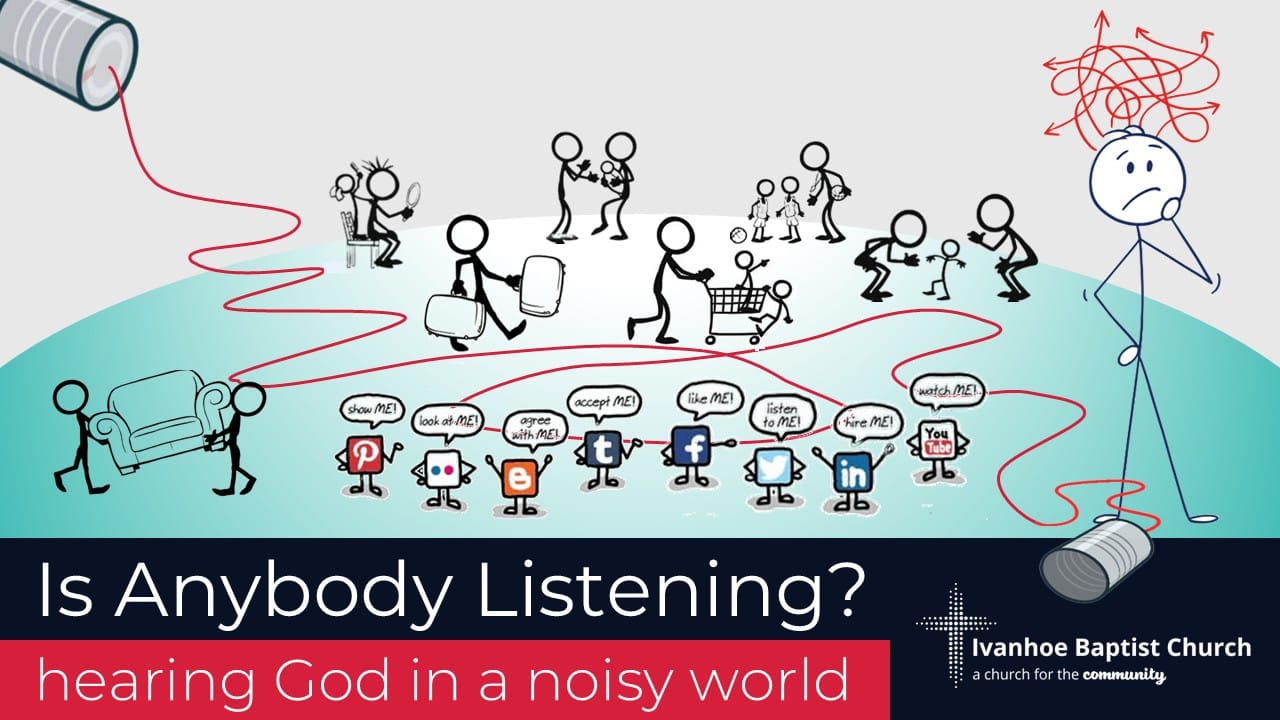
Week 1 - "Speak Lord, your servant is listening"
Each day this week we'll sit slowly with one passage and ask what it shows us about God speaking and about us listening. Set aside a few quiet minutes, read without hurrying, and end each day with a short silence, ready to say with Samuel, "Speak, LORD, for your servant is listening."
Rare in Those Days
A busy sanctuary, a quiet heaven, and a lamp that had not yet gone out.
The first verse of 1 Samuel 3 is easy to hurry past on the way to the voice in the night. Slow down there. "Now the boy Samuel was ministering to the LORD under Eli. The word of the LORD was rare in those days; visions were not widespread." The sanctuary at Shiloh was busy. Offerings were made, the lamp was tended, a boy served in the house of God. And still the word of the LORD was rare.
The Hebrew word translated "rare" usually means precious or costly. It is used of jewels. Rare things become precious, but they can also become things nobody expects any more. The chapter before hints at why the word was scarce: Eli's own sons were priests at the sanctuary, and they treated God and God's offerings with contempt (1 Samuel 2:12–17). When the people closest to the things of God stop listening, it isn't long before nobody expects God to say anything at all. That kind of noise is a quiet one. It is the settled assumption that God doesn't speak, or at least not to people like us.
Then look at what is still there in verse 3. "The lamp of God had not yet gone out." The lamp burned through the night, so this tells us dawn hadn't come yet, and many readers have heard a note of hope in it as well. Samuel was "lying down in the temple of the LORD, where the ark of God was," close to the sign of God's presence with Israel. God had not gone anywhere. The word was rare, but God was about to speak, and to a boy nobody would have picked. On Sunday we wondered whether God speaks more often than we think. This passage suggests the scarcity may say more about the listeners than about God.
- Where in my life is there plenty of religious activity but little expectation that God will actually say anything?
- If God's word is precious, how am I treating it? What place does the Bible have in my ordinary week?
Scripture quotations are from the New Revised Standard Version Updated Edition. Copyright © 2021 National Council of Churches of Christ in the United States of America. Used by permission. All rights reserved worldwide.
A Sound of Sheer Silence
Wind, earthquake and fire pass by Elijah, and then a question in the quiet.
Elijah has just seen fire fall from heaven on Mount Carmel (1 Kings 18). A few days later he is running for his life, and under a broom tree in the wilderness he asks to die: "It is enough; now, O LORD, take away my life" (19:4). God feeds him, and he walks on to Horeb, the mountain of God, and spends the night in a cave.
Notice that God speaks before anything dramatic happens. "Then the word of the LORD came to him, saying, 'What are you doing here, Elijah?'" (v. 9). It is a question, not a lecture. Then comes the great display: a wind strong enough to split mountains, an earthquake, a fire. Elijah knew this kind of God. He had seen the fire. But the text says it three times, plainly. The LORD was not in the wind, not in the earthquake, not in the fire. "And after the fire a sound of sheer silence."
Older translations called it "a still small voice." The Hebrew holds together two things that don't quite fit, a sound and a stillness, and no English version fully settles it. What is clear is that Elijah recognised it. He wrapped his face in his mantle, went out to the entrance of the cave, and heard the same question again (v. 13).
Many of us discount the quiet ways God speaks because we are waiting for the earthquake. We have heard stories of dramatic guidance and assume that is what the real thing looks like. Elijah's story says otherwise. The God who can send fire came to a worn-out prophet in quiet, with a searching question. That quiet sense that won't go away, the question that keeps surfacing as you pray or read, deserves attention. It still needs testing against Scripture and with other people. But it shouldn't be brushed aside as "just me" simply because it is quiet.
- Have I been waiting for something dramatic, and overlooking quieter ways God might be at work?
- If God asked me today, "What are you doing here?", what would my honest answer be?
Scripture quotations are from the New Revised Standard Version Updated Edition. Copyright © 2021 National Council of Churches of Christ in the United States of America. Used by permission. All rights reserved worldwide.
No Speech, Nor Words
The sky speaks without saying a word, and its voice reaches everywhere.
Psalm 19 begins outside, under the open sky. "The heavens are telling the glory of God, and the firmament proclaims his handiwork. Day to day pours forth speech, and night to night declares knowledge." Read it slowly and the verbs pile up: telling, proclaiming, pouring forth, declaring. Creation is not silent. It never stops speaking.
Then comes a turn. "There is no speech, nor are there words; their voice is not heard; yet their voice goes out through all the earth and their words to the end of the world." No words, and yet a voice that reaches everywhere. The sky says something true about God without a single sentence. A spring morning full of birdsong, the light on the Yarra in the evening, a garden coming back to life: none of it comes with captions, and all of it speaks.
We often split life into spiritual parts and ordinary parts, and expect God to speak only in the first. The psalm doesn't split them. The God who made everything can meet us anywhere in it: in the skill of a surgeon, in a meal shared, in the patch of sky above the car park. Then, halfway through, the psalm turns from the sky to "the law of the LORD" (v. 7), the clearer words of Scripture. Creation shows that God is glorious. Scripture tells us who this God is and what this God asks. The psalmist needs both, and so do we.
- Where do I draw a line between the "spiritual" parts of my life and the ordinary ones?
- What might creation have been saying to me lately that I haven't stopped long enough to hear?
Scripture quotations are from the New Revised Standard Version Updated Edition. Copyright © 2021 National Council of Churches of Christ in the United States of America. Used by permission. All rights reserved worldwide.
Be Still
Roaring waters, shaking mountains, nations in an uproar, and in the middle of it all, God speaks.
Psalm 46 is a noisy psalm. The earth changes and the mountains shake in the heart of the sea. Its waters "roar and foam," and "the mountains tremble with its tumult" (v. 3). Nations are in an uproar and kingdoms totter (v. 6). It reads a little like the evening news.
The psalm never pretends the noise isn't there. It starts instead with where God is: "God is our refuge and strength, a very present help in trouble" (v. 1). Not distant from the trouble, but present in it. And right among the roaring waters there is a quieter water, a river that makes the city of God glad (v. 4).
Then, near the end, God speaks: "Be still, and know that I am God! I am exalted among the nations; I am exalted in the earth" (v. 10). The Hebrew word behind "be still" has the sense of letting go, letting your hands drop, stopping. It is spoken in the middle of the uproar, not after it has died down. Stillness here isn't escaping to a place where nothing is happening. It is remembering who is God while everything else is still going on.
We live with a steady stream of news, messages, opinions and alerts, more than we were made to take in. Much of it isn't bad. But it fills every gap, and a God who often speaks quietly is easy to drown out. Being still may begin with something as ordinary as switching things off.
- Which noise around me is loudest at the moment: screens, news, busyness, other people?
- What would it mean for me to let go today, in the middle of things, rather than waiting for life to quieten down?
Scripture quotations are from the New Revised Standard Version Updated Edition. Copyright © 2021 National Council of Churches of Christ in the United States of America. Used by permission. All rights reserved worldwide.
A Quieted Soul
Three short verses, and a picture of a soul at rest with God.
Psalm 131 is only three verses long, and it is meant to be read slowly. "O LORD, my heart is not lifted up; my eyes are not raised too high; I do not occupy myself with things too great and too marvelous for me." A lot of the noise we live with isn't outside us. It's inside: the lists, the worries, the conversations we keep replaying, the need to have everything worked out. The psalmist has stopped trying to carry what is too big to carry.
Then comes one of the tenderest pictures in the Psalms. "But I have calmed and quieted my soul, like a weaned child with its mother; my soul is like the weaned child that is with me." A baby who is still feeding comes to its mother wanting something, and fusses until it gets it. A weaned child can sit on a parent's lap simply to be there. It isn't asking for anything. It is content to be close.
Notice the verb, too: "I have calmed and quieted my soul." It is something the psalmist has done, and probably not all at once. A quiet heart is partly gift and partly practice, and like weaning, it takes time. The psalm ends by turning outward to the whole people: "O Israel, hope in the LORD from this time on and forevermore." A quieted soul hasn't stopped caring. It has put its hope in the right place.
This matters for listening. If our prayer is always a list of requests, and our minds never stop running, it is hard to hear anything. Sometimes the most honest prayer is to sit with God like that weaned child, wanting nothing in particular, simply being there.
- What does the noise inside me sound like at the moment? Which thoughts keep going round and round?
- What am I trying to carry that is "too great and too marvelous" for me?
Scripture quotations are from the New Revised Standard Version Updated Edition. Copyright © 2021 National Council of Churches of Christ in the United States of America. Used by permission. All rights reserved worldwide.
Then Eli Perceived
Samuel hears his name three times and can't tell who is calling, until someone helps him.
Read these verses slowly and you'll notice how much they repeat. The LORD calls. Samuel says "Here I am!" and runs to Eli. "I did not call; lie down again." It happens a second time, and a third. The storyteller wants us to feel how long it takes. Then the narrator explains: "Now Samuel did not yet know the LORD, and the word of the LORD had not yet been revealed to him" (v. 7). In Hebrew, almost the same expression is used of Eli's sons in 1 Samuel 2:12, but without the "yet." They never came to know the LORD. Samuel just didn't know yet.
Samuel couldn't recognise the voice on his own. It took someone else. "Then Eli perceived that the LORD was calling the boy" (v. 8). Eli is no hero in this story. His eyesight is failing, his sons have gone badly wrong, and the word Samuel is about to hear concerns Eli's own house. Yet Eli is the one who sees what is happening. He calls Samuel "my son" (v. 6). He gives him words to say, and they are humble words: "Speak, LORD, for your servant is listening." Then he sends the boy back to listen for himself.
There is a gentle warning here for anyone who is sure they can always hear God clearly on their own. Even Samuel needed help. And there is a pattern for the church. Eli doesn't hear the voice for Samuel, or tell him what God has said. He helps him recognise it and points him back to God. That is what listening together looks like. It isn't one person announcing "God told me" and closing the conversation. It is people helping each other listen, humbly, with the Scriptures open, ready for God to speak through the least likely person in the room.
- When have I been too sure I knew what God was saying, without checking it with anyone?
- Who has been an "Eli" for me, someone who helped me recognise God at work? Who might I help in the same way?
Scripture quotations are from the New Revised Standard Version Updated Edition. Copyright © 2021 National Council of Churches of Christ in the United States of America. Used by permission. All rights reserved worldwide.
Speak, for Your Servant Is Listening
Samuel answers at last, and learns that listening means being ready to act.
The fourth time is different. "Now the LORD came and stood there, calling as before, 'Samuel! Samuel!'" God doesn't only call from a distance. God comes and stands there. When God calls someone's name twice in Scripture, it often marks a turning point, as with Abraham on the mountain and Moses at the burning bush (Genesis 22:11; Exodus 3:4). This time Samuel is ready: "Speak, for your servant is listening."
The Hebrew word for "listening" means more than hearing sounds. It holds hearing and doing together, the way "Hear, O Israel" calls for obedience and not just attention. Samuel's prayer isn't a formula for getting a message. It is a statement of readiness: I'm here, I'm paying attention, and I will do what you say.
That readiness was tested straight away. The first word Samuel received was a hard one, about Eli's own house. He lay there until morning, and "Samuel was afraid to tell the vision to Eli" (v. 15). When Eli pressed him, "Samuel told him everything and hid nothing from him" (v. 18). Listening to God doesn't always bring comfort first. Sometimes it brings a word we would rather not pass on. "As Samuel grew up, the LORD was with him and let none of his words fall to the ground" (v. 19).
Samuel's night belonged to a turning point in Israel's story, when God was raising up a prophet for the whole nation. Most of us will never hear our name called in the dark, and we don't need to. "Long ago God spoke to our ancestors in many and various ways by the prophets, but in these last days he has spoken to us by a Son" (Hebrews 1:1–2). The word is no longer rare. What we can share with Samuel is his readiness. This morning the series turns to Jesus' words in John 10: "My sheep hear my voice. I know them, and they follow me" (v. 27). Hearing and following: the same pair Samuel learned that night.
- Looking back on this week's times of silence, what did you notice about God, about the noise, or about yourself?
- Is there something I already sense God asking of me that I have been slow to act on, or to say?
Scripture quotations are from the New Revised Standard Version Updated Edition. Copyright © 2021 National Council of Churches of Christ in the United States of America. Used by permission. All rights reserved worldwide.