

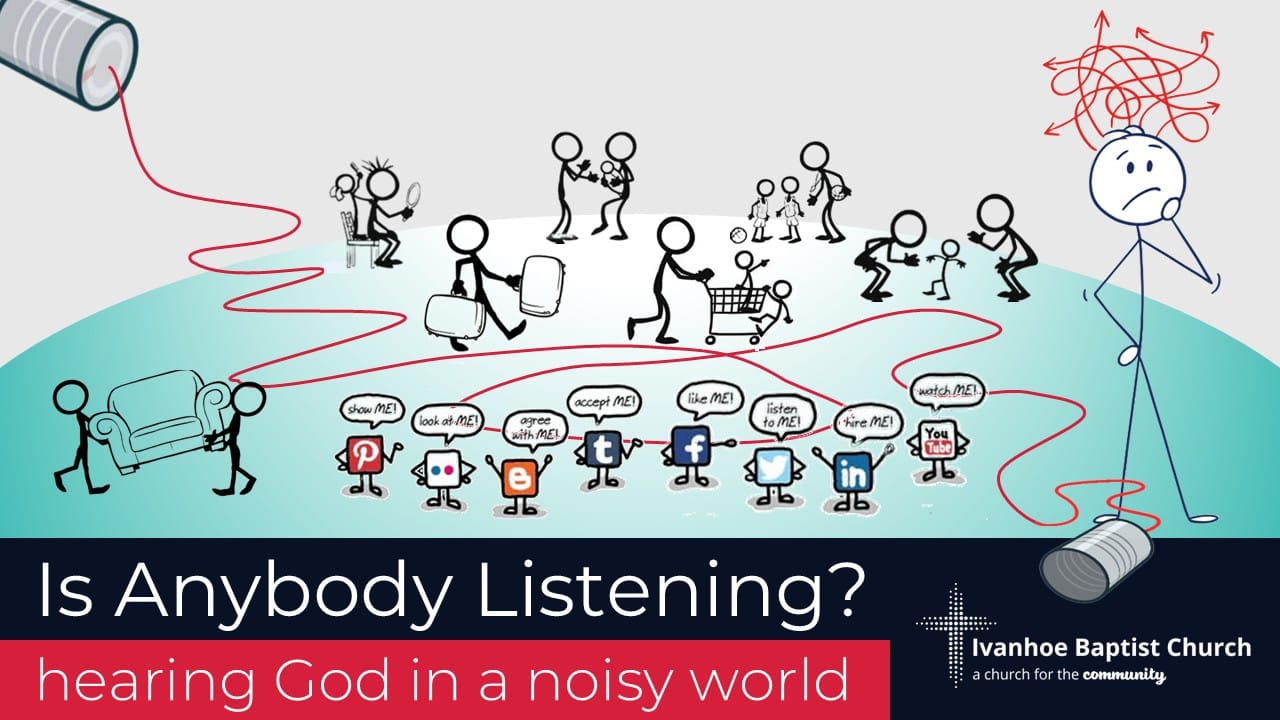
Week 2 - "My sheep hear my voice"
Each day this week we sit with one passage about the Shepherd who knows his sheep and speaks to them. Read slowly, pray, and if you're trying the media fast, give some of the time you get back to the day's reading. "My sheep hear my voice. I know them, and they follow me."
I Myself Will Search
God has had enough of shepherds who look after themselves, and promises to do the job personally.
Ezekiel 34 opens with a complaint. Israel's shepherds, its kings and leaders, had looked after themselves and not the flock. "Should not shepherds feed the sheep?" (v. 2). They hadn't strengthened the weak or gone looking for the lost, and the sheep were scattered (vv. 2–6). Ezekiel was speaking to people in exile in Babylon. They knew what scattered felt like.
Then God answers, and the answer is not a better set of leaders. "For thus says the Lord GOD: I myself will search for my sheep and will sort them out" (v. 11). Read the passage slowly and count how often God says "I": I will search, I will rescue, I will bring them out, I will feed them. "I myself will be the shepherd of my sheep, and I will make them lie down, says the Lord GOD" (v. 15). God takes the job on personally, and goes after them into the places where they were scattered "on a day of clouds and thick darkness" (v. 12).
Verse 16 reads like a job description: "I will seek the lost, and I will bring back the strays, and I will bind up the injured, and I will strengthen the weak." None of these are model sheep. The lost, the strays, the injured and the weak are exactly the ones the old shepherds overlooked, and in God's list they come first.
This chapter stands behind John 10. When Jesus speaks of a shepherd whose sheep know his voice, he is standing inside this promise. On Sunday Craig suggested that the first place to listen for God is Jesus himself, the good Shepherd who is already looking for us. Listening starts with being found.
- Lost, strayed, injured, weak: which of the four in verse 16 sounds most like me this week?
- Where have I assumed that I have to find God, when this passage says God is already searching for me?
Scripture quotations are from the New Revised Standard Version Updated Edition. Copyright © 2021 National Council of Churches of Christ in the United States of America. Used by permission. All rights reserved worldwide.
He Leads Me
The best-known shepherd psalm, and a shepherd you can follow into the dark.
Psalm 23 is so familiar that it is hard to read slowly. Try anyway. "The LORD is my shepherd; I shall not want. He makes me lie down in green pastures; he leads me beside still waters; he restores my soul." In mid-October the paddocks around Melbourne are usually at their greenest, so the picture isn't hard to imagine. Notice who does the work. He makes, he leads, he restores. The sheep's part is to go where it is led.
A shepherd in the psalmist's world walked in front, and the flock followed. You can only follow someone you trust, and you can only trust someone you know. This psalm sounds like it was written by a sheep that has been with this shepherd for a long time, and has learned what he is like by living close to him.
Then the path goes down. "Even though I walk through the darkest valley, I fear no evil, for you are with me; your rod and your staff, they comfort me" (v. 4). Look at the pronouns. Up to here the psalmist talks about the shepherd: he, he, he. In the valley it becomes "you." In the dark, the sheep stops describing the shepherd and starts talking to him. The rod and staff that comfort belong to someone close enough to touch.
The psalm doesn't promise there will be no valley and no enemies. It promises company, a table, and this: "Surely goodness and mercy shall follow me all the days of my life" (v. 6). The shepherd goes ahead, and goodness and mercy come along behind. A lot of the voices in an ordinary week are trying to tell us we are missing something. This one begins, "I shall not want."
- Where am I in this psalm at the moment: green pasture, right path, dark valley, or at the table?
- Which voices have been telling me I'm missing out, and what does "I shall not want" say back to them?
Scripture quotations are from the New Revised Standard Version Updated Edition. Copyright © 2021 National Council of Churches of Christ in the United States of America. Used by permission. All rights reserved worldwide.
He Has Made Him Known
God's word arrives as a person, to be seen as well as heard.
"And the Word became flesh and lived among us, and we have seen his glory, the glory as of a father's only son, full of grace and truth" (v. 14). The Greek word translated "lived" comes from the word for a tent. It recalls the tabernacle, the tent where God's presence lived among Israel in the wilderness.
Now go to the end of the passage. "No one has ever seen God. It is the only Son, himself God, who is close to the Father's heart, who has made him known" (v. 18). The Greek verb behind "made him known" is the one that gives us the word "exegesis," explaining a text. Jesus is God explained. Hebrews says the same thing in its own way: "Long ago God spoke to our ancestors in many and various ways by the prophets, but in these last days he has spoken to us by a Son" (Hebrews 1:1–2). If we want to know what God sounds like, we listen to Jesus.
Notice how much of this passage is about seeing. "We have seen his glory." The Word God spoke wasn't only a sound. It had a face and hands, and a way of treating people. That matters if your hearing isn't what it used to be, or if "hearing God's voice" has always sounded like something that happens to other people. The Shepherd's voice is a picture. We meet him in what Jesus said and did: read on the page, seen in his life, and passed on to us by people who knew him.
And there is plenty to receive. "From his fullness we have all received, grace upon grace" (v. 16). We don't have to squeeze a word out of God. The Word has already come, full, and keeps giving.
- What do I picture when I think of "God speaking"? How does verse 18 change that picture?
- Which story about Jesus shows me most clearly what God is like?
Scripture quotations are from the New Revised Standard Version Updated Edition. Copyright © 2021 National Council of Churches of Christ in the United States of America. Used by permission. All rights reserved worldwide.
Listen to Him
A mountain, a cloud, a voice, and then only Jesus.
Jesus takes Peter, James and John up a high mountain, "and he was transfigured before them, and his clothes became dazzling bright, such as no one on earth could brighten them" (vv. 2–3). Elijah and Moses appear and talk with him. Both of them had met God on a mountain. Moses received the law at Sinai, and Elijah heard the sound of sheer silence at Horeb, one of last week's readings.
Peter responds by talking. "Rabbi, it is good for us to be here; let us set up three tents: one for you, one for Moses, and one for Elijah" (v. 5). Mark explains, kindly: "He did not know what to say, for they were terrified" (v. 6). Most of us know that feeling. When we are anxious, we fill the space with words, plans and things to do. His idea is kindly meant, but it puts Jesus alongside Moses and Elijah, as one great voice among three.
Then the cloud comes down. "This is my Son, the Beloved; listen to him!" (v. 7). In the whole scene, the only words God speaks are an instruction to listen to someone else. Not to Moses or Elijah, much as they matter, but to the Son. It is Hebrews 1:1–2 in a single moment: the prophets, and then the Son.
"Suddenly when they looked around, they saw no one with them any more, but only Jesus" (v. 8). The dazzling light has gone and so have the visitors. What is left is very ordinary: Jesus on a hillside, and a walk back down to a crowd and a worried father (vv. 14–29). That is where listening to him gets worked out, in the ordinary week below the mountain.
- When I'm unsettled, how do I fill the silence, the way Peter did?
- What would "only Jesus" look like in one part of my day today?
Scripture quotations are from the New Revised Standard Version Updated Edition. Copyright © 2021 National Council of Churches of Christ in the United States of America. Used by permission. All rights reserved worldwide.
O That Today
A psalm that starts with a joyful noise and ends with a plea to listen.
Not all noise is the problem. Psalm 95 begins with a crowd making as much of it as they can: "O come, let us sing to the LORD; let us make a joyful noise to the rock of our salvation!" (v. 1). Then the psalm looks around at everything God holds. "In his hand are the depths of the earth; the heights of the mountains are his also. The sea is his, for he made it, and the dry land, which his hands have formed" (vv. 4–5).
Then the volume drops. "O come, let us worship and bow down; let us kneel before the LORD, our Maker!" (v. 6). From singing to kneeling. And here is the reason: "For he is our God, and we are the people of his pasture and the sheep of his hand" (v. 7). The hand that holds the depths of the earth holds the flock as well.
Then comes the line the whole psalm has been leaning towards: "O that today you would listen to his voice!" Today. Not when life calms down, or once I've sorted myself out. The psalm goes on to remember Massah and Meribah, where Israel in the wilderness argued with God over water (Exodus 17:1–7): "Do not harden your hearts" (v. 8). In this psalm, a hard heart doesn't belong to someone who never heard. It belongs to people who heard many times and slowly stopped listening.
Hebrews quotes this psalm and hears the Holy Spirit still saying it to the church: "Today, if you hear his voice" (Hebrews 3:7). That makes every day a "today." It's easy for a week like this one to turn into resolutions about tomorrow. Psalm 95 only asks about today.
- Has any part of my heart grown harder than it used to be, towards God or towards someone else?
- Given what today actually holds, what would it look like for me to listen to his voice today?
Scripture quotations are from the New Revised Standard Version Updated Edition. Copyright © 2021 National Council of Churches of Christ in the United States of America. Used by permission. All rights reserved worldwide.
Called by Name
Mary doesn't recognise Jesus by sight. She knows him when he says her name.
"But Mary stood weeping outside the tomb" (v. 11). The others have gone home. Mary stays. Angels ask why she is crying, and then she turns and sees Jesus standing there, "but she did not know that it was Jesus" (v. 14). She thinks he's the gardener, and asks where he has taken the body.
Grief does that. It narrows what we can see. Mary is looking for a body, and the living Jesus is in front of her, and she can't take it in. Her tears aren't a failure of faith. Jesus meets her in them. If you are grieving this weekend, this story may sit close, and you don't have to make anything of it except that.
Then he says her name. "Jesus said to her, 'Mary!' She turned and said to him in Hebrew, 'Rabbouni!' (which means Teacher)" (v. 16). She doesn't know him by his face. She knows him by the way he says her name. Earlier in John's Gospel Jesus had said of the shepherd, "He calls his own sheep by name and leads them out" (10:3). In the garden, that is exactly what happens.
Mary didn't recognise Jesus by trying harder. He spoke first. Recognition was his gift to her. If you aren't sure you have ever heard the Shepherd, you haven't been left out. In John 10:27 Jesus says "I know them" before he says "they follow me." Hearing her name also sends Mary somewhere. "Mary Magdalene went and announced to the disciples, 'I have seen the Lord'" (v. 18). The one who was called by name becomes the first to tell.
- When has grief or worry narrowed what I could see of God?
- How might my day change if I believed Jesus knows my name as surely as he knew Mary's?
Scripture quotations are from the New Revised Standard Version Updated Edition. Copyright © 2021 National Council of Churches of Christ in the United States of America. Used by permission. All rights reserved worldwide.
The Shepherd Who Stays
A shepherd who doesn't run when the wolf comes, and who knows his own.
"I am the good shepherd. The good shepherd lays down his life for the sheep" (v. 11). Jesus sets this against the hired hand, "who is not the shepherd and does not own the sheep" (v. 12). When the wolf comes, the hired hand runs away, "because a hired hand does not care for the sheep" (v. 13). The difference shows when caring starts to cost something.
Then Jesus says, "I know my own, and my own know me, just as the Father knows me, and I know the Father" (vv. 14–15). The knowing between Jesus and his sheep is set beside the knowing between the Father and the Son. That is where the Shepherd's voice comes from. We learn to recognise it because he has known us first, and because he gives himself for us: "And I lay down my life for the sheep" (v. 15).
Today we welcome guests from BaptistCare. Care that stays when things get hard is a small picture of this Shepherd: sitting with someone whose memory is fading, helping in the middle of the night, standing by a family doing it tough. Some of us give that kind of care, and some of us receive it. Neither is a lesser way of following Jesus.
This evening at 5pm in the LCC there is Prayer around the Cross echoing something of the Taizé tradition, with simple sung verses, a reading, and a long silence. The cross is where verse 15 came true. You don't need to bring anything, or come away having heard anything in particular. Sit near the Shepherd who laid down his life, and let him know you, as he already does. If you can't be there, a few quiet minutes at home with this passage and the same invitation.
- Looking back on this week's fast, what did you reach for, and what did you finally have room to take in?
- Who has cared for me in a way that stayed when it cost them? How can I thank God for them, and thank them?
Scripture quotations are from the New Revised Standard Version Updated Edition. Copyright © 2021 National Council of Churches of Christ in the United States of America. Used by permission. All rights reserved worldwide.